If your business isn’t showing up when people search for what you offer, you’re losing customers to competitors who are. That’s the blunt truth about doing business in 2026. A good product or service isn’t enough anymore. You need a digital marketing agency that understands how people search, scroll, and shop today — and how to put your brand in front of them at exactly the right moment.
At NexGN Solution, we’ve spent years helping businesses of every size — from local shops to fast-growing startups — turn their websites and social channels into real revenue engines. This guide brings together everything we’ve learned. Whether you’re trying to understand what digital marketing actually means, comparing agencies, or looking for a step-by-step strategy you can act on today, you’ll find it here.
What Is Digital Marketing?
Digital marketing is the practice of promoting products, services, or brands using online channels such as search engines, social media, email, websites, and paid ads. Instead of relying on billboards, TV spots, or newspaper ads, digital marketing meets people where they already spend most of their time: on their phones and computers.
In simple terms, digital marketing is how businesses get found, get remembered, and get chosen, online.
It covers a wide range of activities, including:
- Search engine optimisation (SEO)
- Pay-per-click advertising (PPC)
- Social media marketing
- Content marketing
- Email marketing
- Affiliate and influencer marketing
- Marketing automation and AI-driven personalization
A Brief History of Digital Marketing
Digital marketing didn’t appear overnight. In the 1990s, the first banner ads and simple websites marked the earliest stages. The 2000s brought search engines into the mainstream, giving rise to SEO as a discipline. Social platforms exploded in the 2010s, turning marketing into a two-way conversation instead of a one-way broadcast. Now, in the mid-2020s, AI-powered search and generative tools are reshaping how people find information again, which is exactly why understanding both classic SEO and newer Generative Engine Optimization (GEO) matters for any modern digital marketing strategy.
Understanding this evolution matters because many of the “rules” business owners learned five or ten years ago no longer apply the same way. Keyword stuffing, for instance, used to work. Today it triggers penalties. Cold, generic content used to rank. Today, Google’s Helpful Content system actively downranks it in favor of pages that show real experience and expertise.
Digital Marketing vs. Traditional Marketing
| Factor | Digital Marketing | Traditional Marketing |
|---|---|---|
| Reach | Global, targeted | Local, broad |
| Cost | Flexible, scalable | Often high, fixed |
| Measurability | Real-time analytics | Difficult to track |
| Targeting | Precise (age, location, interest, behavior) | General |
| Speed | Instant results possible | Slow rollout |
| Personalization | High | Low |
Traditional marketing still has a place — especially for brand awareness in local communities — but for most businesses today, digital channels deliver far better return on investment.
Why Digital Marketing Matters in 2026
Consumer behavior has shifted permanently. People research products on their phones before ever walking into a store. They read reviews, compare prices, and check social proof before making a decision. If your business isn’t visible during that research phase, you don’t exist to that customer.
A few realities driving this shift in 2026:
- Mobile-first behavior is the norm. Most searches and purchases now start on a smartphone.
- AI-powered search is changing discovery. Tools like Google AI Overviews, ChatGPT, Gemini, and Perplexity increasingly answer questions directly, pulling from well-structured, trustworthy content.
- Attention is fragmented. People split their time across search engines, social apps, video platforms, and messaging apps — so a single-channel approach no longer works.
- Privacy changes have reshaped targeting. With cookie restrictions and privacy-first browsing, first-party data and quality content matter more than ever.
- Local competition is fiercer. Even neighborhood businesses now compete for visibility in local search results and map listings.
“The businesses that win in 2026 aren’t necessarily the ones with the biggest budgets. They’re the ones who show up consistently, answer real customer questions, and build trust over time.” — NexGN Solution Strategy Team
The Cost of Standing Still
Consider two competing bakeries in the same neighborhood. One posts consistently on Instagram, keeps its Google Business Profile updated with photos and hours, and responds to every review. The other relies purely on foot traffic and word of mouth. Within a year, the first bakery typically captures a far larger share of local searches for “bakery near me,” simply because it shows up more often, looks more trustworthy, and gives Google (and potential customers) more signals to work with.
This dynamic repeats across nearly every industry — home services, healthcare, retail, professional services, and e-commerce alike. The businesses investing in digital visibility aren’t just winning today’s customers; they’re building a compounding advantage that gets harder for latecomers to close.
Benefits of Digital Marketing
Why should a business invest time and budget into digital marketing? Because the returns, when done correctly, are measurable and compounding.
Core Benefits
- Wider reach — Connect with audiences beyond your local area, or hyper-target a specific neighborhood.
- Cost efficiency — Compared to TV or print, digital channels often cost less per lead or sale.
- Precise targeting — Reach people based on age, location, interests, device, income, and even past behavior.
- Measurable ROI — Track clicks, conversions, cost per lead, and revenue in real time.
- Better customer relationships — Email, social media, and chat let you talk directly with customers.
- Level playing field — A small business with smart strategy can outrank or outperform a much bigger competitor.
- Flexibility — Campaigns can be paused, adjusted, or scaled instantly based on performance.
Case Example
A regional HVAC company partnered with a digital marketing agency to run local SEO and Google Ads campaigns. Within six months, their inbound calls from search increased significantly, and their cost per lead dropped as the campaigns were optimized. This is a common pattern: initial investment followed by improving efficiency as data accumulates.
Additional Benefits Worth Noting
Beyond the core list above, digital marketing offers a few benefits that businesses often underestimate until they experience them firsthand.
- Reputation building over time. Every blog post, social update, and review response adds to a public record that new customers can research before ever contacting you.
- Faster feedback loops. Instead of waiting weeks for market research, you can test a headline, offer, or image and know within days how your audience responds.
- Better customer insights. Analytics reveal not just how many people bought, but who they are, what device they used, and what content convinced them — insights traditional marketing rarely provides.
- Resilience during downturns. Because digital campaigns can be scaled up or down quickly, businesses have more flexibility to manage marketing spend during slow periods compared to fixed traditional media contracts.
Industry benchmarking reports from sources like HubSpot and Statista consistently show that businesses combining SEO, paid search, and email marketing report higher customer lifetime value than those relying on a single channel alone.
Types of Digital Marketing
Digital marketing isn’t a single discipline — it’s a collection of specialized channels. Here’s a breakdown of the major types, what they do, and when to use them.
SEO (Search Engine Optimisation)
SEO is the process of improving a website so it ranks higher in search engine results for relevant keywords, without paying for ads. It includes technical SEO (site speed, mobile-friendliness, structure), on-page SEO (content, keywords, headings), and off-page SEO (backlinks, authority building).
SEO is a long-term investment. It typically takes a few months to see meaningful movement, but the traffic it generates is largely free and compounds over time.
Local SEO
Local SEO focuses on getting a business found in location-based searches — think “plumber near me” or “best coffee shop in [city].” It relies heavily on Google Business Profile optimisation, local citations, reviews, and location-specific content. For brick-and-mortar businesses, local SEO is often the single highest-ROI channel available.
Content Marketing
Content marketing means creating valuable, relevant content — blog posts, guides, videos, infographics — to attract and engage an audience. It supports SEO, builds authority, and answers the questions your potential customers are already asking. Good content marketing also feeds the newer world of AI search, since AI Overviews and chatbots tend to pull from clear, well-organised, trustworthy sources.
PPC (Pay-Per-Click Advertising)
PPC is advertising where you pay only when someone clicks your ad. It includes search ads, display ads, and shopping ads. PPC delivers fast, predictable traffic, making it ideal for businesses that need results quickly or want to test new offers.
Google Ads
Google Ads is the most widely used PPC platform, placing your business at the top of search results and across the Google Display Network, YouTube, and Gmail. A well-managed Google Ads account requires ongoing keyword research, bid management, and ad copy testing.
Meta Ads (Facebook & Instagram Advertising)
Meta Ads run across Facebook and Instagram, letting businesses target audiences based on demographics, interests, and behaviors. These platforms are especially strong for visual products, retargeting website visitors, and building brand awareness among specific audience segments.
Social Media Marketing
Social media marketing covers organic posting, community engagement, and brand building across platforms like Instagram, Facebook, LinkedIn, TikTok, and X. It’s less about direct sales and more about staying visible, building trust, and humanizing your brand.
Email Marketing
Despite being one of the oldest digital channels, email marketing remains one of the highest-ROI tactics available. It’s used for nurturing leads, promoting offers, re-engaging past customers, and building long-term relationships through newsletters and automated sequences.
Influencer Marketing
Influencer marketing involves partnering with individuals who have an engaged audience to promote your product or service. It works especially well for consumer brands looking to build credibility quickly through trusted voices.
Video Marketing
Video marketing uses platforms like YouTube, TikTok, Instagram Reels, and even website landing pages to explain products, build trust, and boost engagement. Video content tends to hold attention longer than text or static images, and it’s increasingly favored by search and social algorithms.
Affiliate Marketing
Affiliate marketing pays partners a commission for driving sales or leads through their own promotional efforts. It’s a performance-based model, meaning you only pay for actual results, making it attractive for businesses focused on measurable ROI.
Comparison Table: Choosing the Right Channel
| Channel | Best For | Speed of Results | Typical Cost |
|---|---|---|---|
| SEO | Long-term organic traffic | Slow (3-6+ months) | Medium |
| Local SEO | Local businesses | Medium | Low-Medium |
| Content Marketing | Authority & trust | Slow-Medium | Medium |
| PPC / Google Ads | Fast, predictable leads | Fast | Medium-High |
| Meta Ads | Visual brands, retargeting | Fast | Medium |
| Social Media | Brand awareness, engagement | Medium | Low-Medium |
| Email Marketing | Retention, nurturing | Fast | Low |
| Influencer Marketing | Credibility, reach | Fast-Medium | Medium-High |
| Video Marketing | Engagement, explanation | Medium | Medium |
| Affiliate Marketing | Performance-based sales | Medium | Low (commission-based) |
How These Channels Work Together
It helps to picture these channels as parts of one system rather than separate campaigns. SEO and content marketing bring people in through search. PPC and Meta Ads accelerate visibility while organic efforts build. Email marketing and marketing automation keep those leads warm until they’re ready to buy. Social media marketing keeps your brand present between purchases, and video marketing reinforces trust across nearly every stage of that journey.
A simple example: a potential customer sees a short video ad on Instagram (video marketing + Meta Ads), searches your brand name on Google a few days later and finds a helpful blog post (SEO + content marketing), signs up for a discount through an email popup (email marketing), and eventually converts after a retargeting ad reminds them to finish checkout (PPC). No single channel gets full credit — the system as a whole does the work.
Digital Marketing Solutions by Business Type
| Business Type | Recommended Primary Channels |
|---|---|
| Local service business | Local SEO, Google Ads, reviews management |
| E-commerce brand | Meta Ads, email marketing, influencer marketing, SEO |
| B2B / professional services | LinkedIn marketing, content marketing, SEO, email nurturing |
| Restaurants & retail | Local SEO, social media, video marketing |
| Startups & SaaS | Content marketing, SEO, paid search, marketing automation |
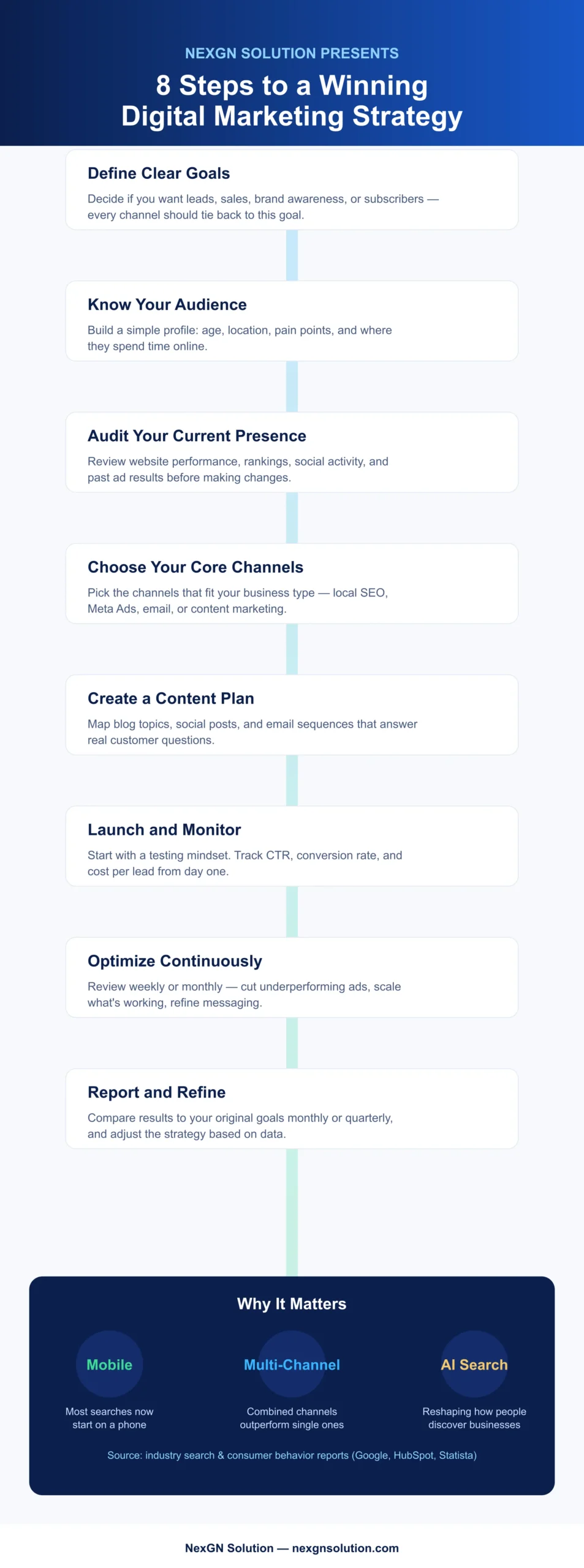
Digital Marketing Strategy Step-by-Step
Running random campaigns without a plan wastes money. Here’s a practical, step-by-step framework we use with clients at NexGN Solution.
Step 1: Define Clear Goals
Are you trying to generate leads, sell products, build brand awareness, or grow email subscribers? Every channel and tactic should tie back to a specific, measurable goal.
Step 2: Know Your Audience
Build a simple customer profile: age range, location, pain points, and where they spend time online. Without this, targeting becomes guesswork.
Step 3: Audit Your Current Presence
Check your website performance, search rankings, social media activity, and past ad results. You can’t improve what you haven’t measured.
Step 4: Choose Your Core Channels
Not every business needs every channel. A local service business might prioritize local SEO and Google Ads, while an e-commerce brand might lean into Meta Ads, email marketing, and influencer partnerships.
Step 5: Create a Content Plan
Map out blog topics, social posts, and email sequences that answer real customer questions and support your SEO goals.
Step 6: Launch and Monitor
Start campaigns with a testing mindset. Track click-through rates, conversion rates, and cost per lead from day one.
Step 7: Optimize Continuously
Digital marketing isn’t “set and forget.” Weekly or monthly reviews let you cut underperforming ads, scale winning ones, and refine messaging.
Step 8: Report and Refine
Review results against your original goals every month or quarter, and adjust your strategy based on what the data shows.
Expert Tip
Start with one or two channels you can execute well, rather than spreading a small budget across five channels you can’t properly manage.
A Realistic Timeline
Business owners often ask how quickly they can expect results. Here’s a realistic breakdown based on typical campaign patterns:
- Weeks 1-4: Setup, audits, tracking installation, and initial campaign launches. Early PPC traffic may start immediately, but data is still too limited to optimize heavily.
- Months 2-3: Enough data accumulates to start refining targeting, ad creative, and content topics. Early SEO improvements (technical fixes, on-page optimization) begin to show small ranking movement.
- Months 4-6: Content marketing and SEO start contributing meaningful organic traffic. PPC campaigns are typically well-optimized by this stage, with lower cost per lead than at launch.
- Months 6-12: Compounding effects kick in — organic rankings climb, email lists grow, and brand recognition builds, often reducing overall cost per acquisition across all channels.
Setting these expectations upfront with your team or agency prevents the common mistake of abandoning a strategy just as it’s about to pay off.
How to Choose the Best Digital Marketing Agency
Not all agencies are created equal. Here’s what actually matters when comparing options.
What to Look For
- Proven results — Ask for case studies or examples relevant to your industry.
- Transparent reporting — You should always know where your budget is going and what it’s producing.
- Clear communication — A good agency explains strategy in plain language, not just jargon.
- Custom strategy — Be wary of agencies offering identical packages to every client regardless of industry.
- Full-service capability — SEO, PPC, content, and social media perform better together than in isolation.
- Honest expectations — Agencies promising “guaranteed #1 rankings” or overnight results are a red flag.
Agency Comparison Table
| Factor | Freelancer | In-House Team | Digital Marketing Agency |
|---|---|---|---|
| Cost | Low | High | Medium |
| Range of skills | Limited | Depends on hiring | Broad, specialized |
| Scalability | Low | Medium | High |
| Tools & Access | Limited | Varies | Enterprise-level |
| Accountability | Informal | Direct | Contractual |
Common Myth
Myth: “The cheapest agency will save me money.” Reality: Underpriced services often mean under-delivered results — cut corners on strategy, reporting, or ad management usually cost more in wasted budget than they save upfront.
Red Flags to Watch For
- Vague or missing reporting after the first month
- Reluctance to share past client results or references
- Locking you into long contracts with no clear exit terms
- Overpromising rankings or results with specific, guaranteed numbers
- One-size-fits-all packages regardless of your industry or goals
Green Flags Worth Prioritizing
- Clear onboarding process with defined milestones
- Willingness to explain strategy in plain language
- Case studies or references from businesses similar to yours
- Transparent, itemized pricing
- A dedicated point of contact who understands your business goals, not just your account number
Choosing the right digital marketing expert or agency partner is as much about fit and communication style as it is about technical skill. The best results come from a genuine, ongoing collaboration — not a one-time transaction.
Services Offered by NexGN Solution
NexGN Solution is a full-service digital marketing agency built to help businesses grow through data-driven, transparent strategy. Our core services include:
- Search Engine Optimisation (SEO) — technical audits, on-page optimization, content strategy, and link building
- Local SEO — Google Business Profile management, citation building, review generation
- PPC & Google Ads Management — search, display, and shopping campaigns built around measurable ROI
- Meta Ads & Facebook Advertising: creative-led campaigns across Facebook and Instagram
- Social Media Marketing & Management: content calendars, community management, and paid social
- Content Marketing Services: blogs, guides, and long-form resources built for both readers and search engines
- Email Marketing Services: automated sequences, newsletters, and lifecycle campaigns
- Website Design & Web Development: fast, conversion-focused websites built on modern platforms
- Conversion Rate Optimization (CRO): landing page testing and funnel improvements
- Marketing Automation: connecting your tools so leads are nurtured automatically
- AI Marketing Services: using AI tools for personalization, content support, and campaign optimization
- Lead Generation Services:building predictable pipelines of qualified leads
- Digital Branding: positioning, messaging, and visual identity that builds trust
We tailor these into digital marketing packages based on business size, industry, and goals — whether you’re a small local business or a growing enterprise looking for a dedicated digital marketing consultant and team.
Why This Matters
Working with one accountable digital marketing company instead of juggling multiple freelancers means your SEO, ads, content, and social all support each other instead of working in silos.
Our Approach
At NexGN Solution, every engagement starts with research, not templates. We study your industry, competitors, and audience before recommending a single tactic. From there, we build a custom roadmap, set clear KPIs, and report results in plain language every month — so you always know exactly what’s working and why.
We also believe in staying ahead of how people actually search today. That means optimizing not just for traditional Google rankings, but for how your business appears in AI-powered tools like Google AI Overviews and conversational assistants — an area many agencies have been slow to adapt to.
A Note on Industries We Serve
Our team has hands-on experience across home services, healthcare, e-commerce, hospitality, real estate, professional services, and B2B technology. Each industry has different buyer behavior, seasonality, and competitive dynamics, and our strategies reflect that — we don’t apply a generic playbook regardless of who you serve.
Why Businesses Need a Digital Marketing Agency
Some businesses try to manage digital marketing in-house, and for a few, that works. But most run into the same walls:
- Lack of specialised expertise — SEO, PPC, and social media each require distinct, evolving skill sets.
- Time constraints — Business owners are busy running operations, not managing ad accounts.
- Tool costs — Professional SEO and ad platforms are expensive to license individually.
- Slow learning curve — Mistakes made while learning cost real ad budget.
- Missed opportunities — Trends and algorithm changes move fast; agencies track them daily so you don’t have to.
An experienced online marketing agency brings a team of specialists, established processes, and access to enterprise tools — often for less than the cost of hiring a full in-house team.
Pros and Cons of Hiring an Agency
| Pros | Cons |
|---|---|
| Access to a full team of specialists | Requires clear communication and trust |
| Established processes and tools | Less day-to-day control than in-house |
| Faster time to results | Ongoing monthly investment |
| Scalable as your business grows | Requires vetting to find the right fit |
A Simple Way to Decide
If your business generates enough revenue that even a modest improvement in leads or sales would clearly justify a monthly marketing investment, an agency partnership almost always pays for itself faster than building an equivalent in-house team. If you’re an early-stage business testing your offer before scaling, starting with a consultant or a narrower engagement (like SEO or PPC alone) can be a reasonable middle ground before expanding into full-service support.
Common Digital Marketing Mistakes
Even well-funded campaigns fail when these mistakes go unchecked.
- No clear goals — Running ads or posting content without a defined objective.
- Ignoring mobile experience — A slow or clunky mobile site kills conversions.
- Inconsistent branding — Different messaging across channels confuses customers.
- Chasing vanity metrics — Likes and followers don’t pay the bills; leads and sales do.
- Neglecting SEO basics — Skipping technical fixes and quality content in favor of only paid ads.
- Poor targeting — Broad, unfocused ad targeting wastes budget fast.
- No tracking setup — Without analytics and conversion tracking, you’re flying blind.
- Giving up too early — SEO and content marketing take months to show full results; abandoning them too soon wastes prior investment.
- Overlooking reviews and reputation — Ignoring negative reviews or failing to request positive ones hurts local search visibility.
- One-and-done content — Publishing once and never updating or promoting content limits its long-term value.
A Closer Look: The “Set and Forget” Trap
One of the most expensive mistakes we see is businesses treating a website launch or an initial ad campaign as a finish line rather than a starting point. Search algorithms update regularly, ad platforms shift auction dynamics, and audience behavior changes with the seasons. A campaign that performed well six months ago may be underperforming today simply because competitors have caught up or platform rules have changed. Building in a regular review cadence — weekly for paid ads, monthly for SEO and content — prevents small issues from becoming expensive ones.
Latest Digital Marketing Trends
Digital marketing evolves constantly. Here’s what’s shaping strategy heading through 2026.
- AI-generated and AI-assisted content — Used for drafting, personalization, and scaling content production, though human review remains critical for quality and trust.
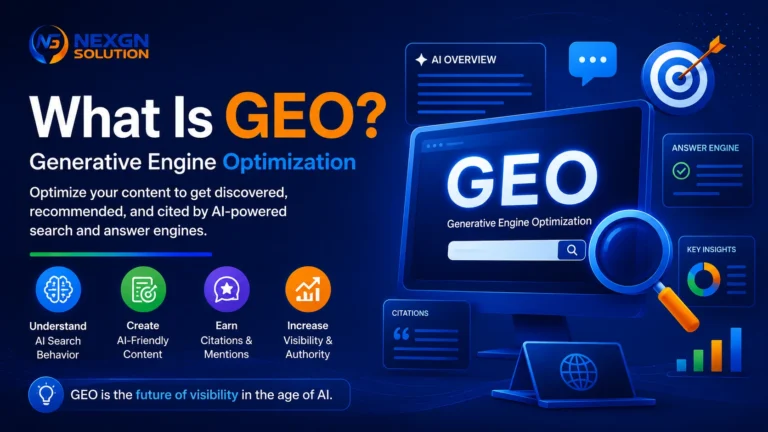
- Generative Engine Optimization (GEO) — Optimizing content so it gets cited and summarized correctly by AI Overviews, ChatGPT, Gemini, Perplexity, and Claude, not just ranked in traditional search.
- Short-form video dominance — Reels, TikTok, and YouTube Shorts continue driving engagement, especially among younger audiences.
- First-party data strategies — As third-party cookies fade, businesses are investing more in email lists, loyalty programs, and direct customer data.
- Voice and conversational search — More searches are phrased as natural questions, rewarding content written in a clear, conversational tone.
- Hyper-personalization — Marketing automation platforms now personalize emails, ads, and website content at the individual level.
- Community-driven marketing — Brands building engaged private communities (Discord, Facebook Groups, forums) to deepen loyalty beyond public feeds.
- Sustainability and authenticity messaging — Consumers increasingly favor brands that communicate honestly about values and practices.
How to Act on These Trends
You don’t need to chase every trend at once. Instead, audit your current strategy against this list once a quarter and ask: are we missing a channel our competitors are already using? Are we still relying entirely on third-party ad targeting without building our own email list? Is our content genuinely answering questions, or just repeating generic industry talk? Small, consistent adjustments based on these questions tend to outperform dramatic, reactive overhauls.
AI in Digital Marketing
Artificial intelligence has moved from buzzword to daily tool across nearly every part of digital marketing.
Where AI Is Being Used
- Content creation support — Drafting outlines, headlines, and first drafts that humans then refine
- Ad optimisation — Platforms like Google Ads and Meta Ads use AI to automatically test and adjust bids, audiences, and creative
- Chatbots and customer service — AI-powered chat handles common questions instantly, improving conversion and response time
- Predictive analytics — Forecasting which leads are most likely to convert, so sales and marketing teams focus effort efficiently
- Personalization engines — Recommending products or content based on individual browsing behavior
- SEO and GEO analysis — AI tools help identify content gaps and structure pages so they get picked up correctly by AI search tools
A Word of Caution
AI is a powerful assistant, not a replacement for strategy. Content that’s fully AI-generated without human insight, editing, or real expertise tends to underperform — both with readers and with search engines that increasingly reward genuine experience and originality (a core part of Google’s E-E-A-T standards).
“AI can speed up production, but it can’t replace judgment, brand voice, or real customer understanding. The agencies and businesses that win combine AI efficiency with human expertise.” — NexGN Solution Strategy Team
How NexGN Solution Uses AI Responsibly
We use AI tools to speed up research, surface data patterns, and support content drafts — but every strategy recommendation, piece of published content, and campaign decision is reviewed by an experienced strategist before it reaches a client. This hybrid approach gives clients the speed benefits of AI without sacrificing the accuracy, nuance, and originality that both customers and search engines reward.
Digital Marketing Tools
Here are categories of tools commonly used by agencies and in-house teams alike:
| Category | Example Tool Types | Purpose |
|---|---|---|
| SEO | Keyword research & rank tracking platforms | Find and track ranking opportunities |
| Analytics | Web analytics platforms | Measure traffic and behavior |
| PPC | Ad platform dashboards | Manage and optimize paid campaigns |
| Email Marketing | Email automation platforms | Send and automate email campaigns |
| Social Media | Scheduling & analytics tools | Plan and measure social content |
| Graphic Design | Graphic design tools | Create ad creatives and content visuals |
| CRO | Heatmap & A/B testing tools | Improve website conversion rates |
| Automation | Marketing automation platforms | Connect tools and nurture leads automatically |
| Project Management | Task & workflow tools | Keep marketing teams organized |
Key Digital Marketing Terms to Know
A quick glossary can help if you’re newer to the space:
- CTR (Click-Through Rate): The percentage of people who click an ad or link after seeing it.
- CPC (Cost Per Click): How much you pay, on average, for each click on a paid ad.
- CPA (Cost Per Acquisition): The average cost to acquire one customer or lead.
- ROAS (Return on Ad Spend): Revenue generated for every dollar spent on advertising.
- Conversion Rate: The percentage of visitors who complete a desired action, like a purchase or form submission.
- Organic Traffic: Visitors who arrive at your site through unpaid search results.
- Backlink: A link from another website pointing to yours, which supports SEO authority.
- Impressions: The number of times an ad or piece of content is displayed, regardless of clicks.
- Bounce Rate: The percentage of visitors who leave a site after viewing only one page.
- Funnel: The stages a customer moves through, from first awareness of a brand to final purchase.
Frequently Asked Questions
1. What does a digital marketing agency do?
A digital marketing agency plans, executes, and manages online marketing campaigns — including SEO, PPC, social media, content, and email — to help businesses attract customers and grow revenue.
2. How much does digital marketing cost?
Costs vary widely based on services, industry, and competition, ranging from a few hundred dollars a month for small local campaigns to several thousand for comprehensive, multi-channel strategies.
3. What is the difference between SEO and PPC?
SEO builds organic (unpaid) visibility over time through content and technical optimization, while PPC delivers immediate, paid visibility that stops once you stop paying.
4. Is digital marketing worth it for small businesses?
Yes. Digital marketing often delivers a better return on investment than traditional advertising because it allows precise targeting and clear performance tracking, even on modest budgets.
5. What is the best digital marketing strategy for a new business?
Start with a professional website, local SEO if you serve a specific area, and one paid channel (like Google Ads) to generate early traction while organic strategies build.
6. What is a digital marketing consultant?
A digital marketing consultant advises businesses on strategy, channel selection, and campaign planning, often without directly executing the day-to-day work an agency would handle.
7. How is AI changing digital marketing?
AI is speeding up content creation, improving ad targeting, powering chatbots, and reshaping how people search — making structured, trustworthy content more important than ever.
8. What is the difference between digital marketing and internet marketing?
The terms are largely interchangeable today, though “internet marketing” is an older term that generally refers to the same set of online promotional activities as “digital marketing.
Final Conclusion
Digital marketing isn’t a single tactic; it’s the combined effort of SEO, content, paid ads, social media, and email working together to build visibility, trust, and revenue. Businesses that treat it as a core growth function, backed by clear goals and consistent execution, consistently outperform those treating it as an afterthought.
Whether you’re just starting to explore what a digital marketing agency can do for your business, or you’re ready to scale an existing strategy, the fundamentals stay the same: know your audience, choose the right channels, track what matters, and stay consistent long enough for results to compound.
Get Started With NexGN Solution
You don’t have to figure this out alone. NexGN Solution has helped businesses across industries build digital marketing strategies that actually move the needle, more traffic, more leads, and more revenue.
Ready to grow your business online? Contact NexGN Solution today for a free strategy consultation and see exactly how a tailored digital marketing plan can work for you.