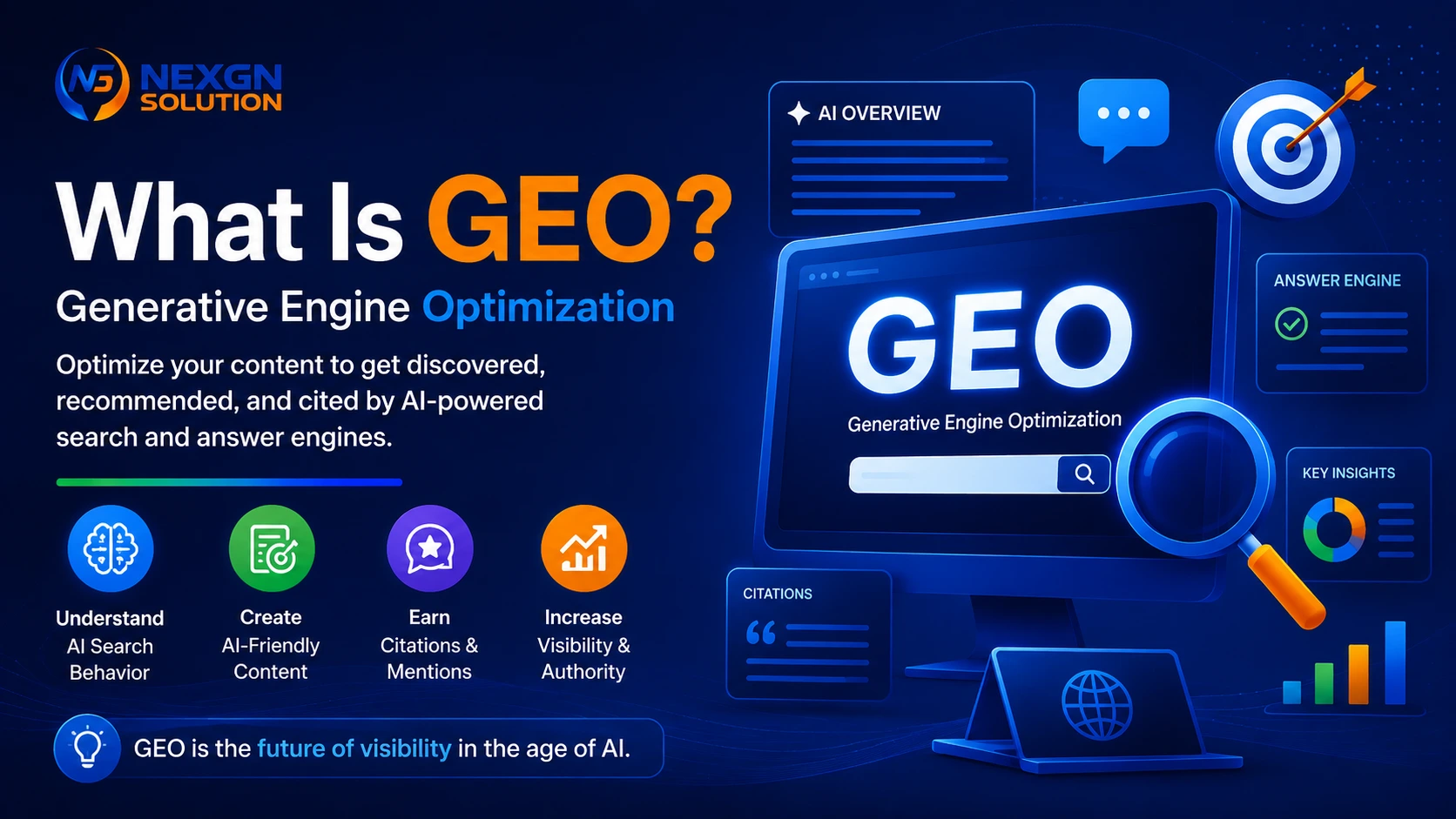
If you’ve typed a question into ChatGPT, Gemini, or Google’s AI Overviews recently, you’ve probably noticed something: you got an answer, not a list of links. That shift is why Generative Engine Optimization (GEO) has become one of the most searched marketing terms of 2026.
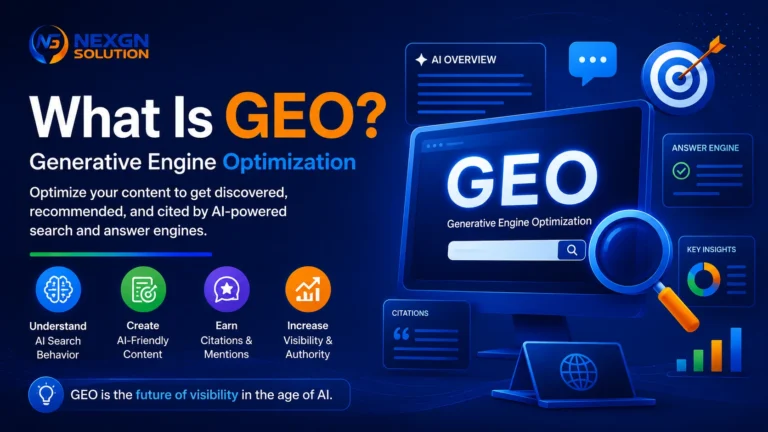
GEO is the practice of structuring your website’s content, data, and authority signals so that AI systems can understand, trust, and cite your business when they generate answers. It’s not a replacement for SEO — it’s the next layer on top of it.
This guide walks through what GEO actually is, how it’s different from SEO and AEO, exactly how generative engines decide what to cite, and a step-by-step checklist you can use to start optimizing today.
What Is Generative Engine Optimization (GEO)?
Generative Engine Optimization (GEO) is the process of optimizing digital content so that AI-powered systems, ChatGPT, Google Gemini, Perplexity, Claude, and Google AI Overviews — can accurately extract, understand, and cite it when generating answers to user questions.
Where traditional SEO earns you a ranked position on a results page, GEO earns you a mention (and ideally a link) inside an AI-generated answer. The reader never has to click through ten blue links; the AI does the reading for them and synthesizes a response from multiple sources. GEO is about becoming one of those sources.
The term traces back to academic research on how generative AI systems select and weight source material, and it has since become a standard part of the digital marketing vocabulary alongside SEO and AEO.
Quick answer
GEO = optimizing content so AI tools cite your brand in their answers, instead of just ranking your page in search results.
GEO vs. SEO vs. AEO — What’s the Actual Difference?
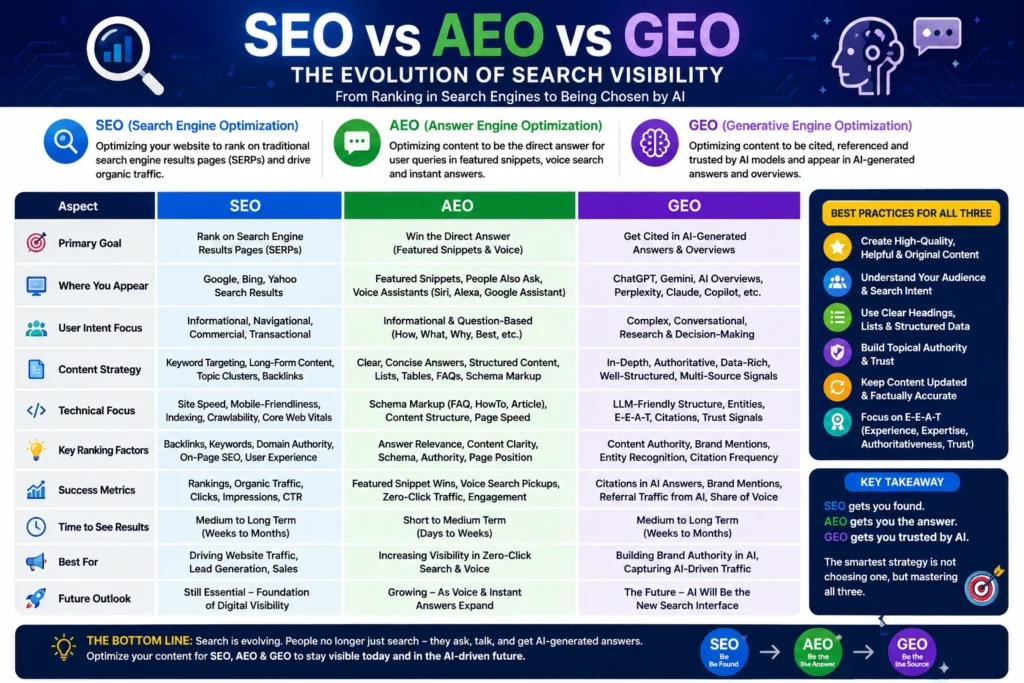
These three terms get used interchangeably, which causes real confusion. Here’s the clearest way to separate them:
| Search Engine Optimization (SEO) | Answer Engine Optimization (AEO) | Generative Engine Optimization (GEO) | |
| Goal | Rank your page on Google’s results | Get selected as a direct answer (featured snippets, voice search) | Get cited or referenced inside an AI-generated response |
| Where it shows up | Search engine results pages | Featured snippets, “People Also Ask,” voice assistants | ChatGPT, Gemini, Perplexity, Google AI Overviews |
| Content format that wins | Keyword-targeted pages, backlinks, technical SEO | Short, direct, extractable answers | Comprehensive, well-structured, entity-rich content |
| User experience | User clicks through to your site | User reads a short answer, may click | User reads a synthesized answer; your brand may or may not get a visible link |
| Primary metric | Rankings, organic traffic | Snippet ownership, voice answer share | AI citation frequency, brand mention rate |
The important thing to understand: these aren’t competing strategies. They’re layered. Strong SEO fundamentals, technical health, authority, quality content — are still the foundation. AEO builds direct-answer formatting on top of that foundation. GEO extends the same principles into how AI systems retrieve and synthesize information. If you’re only doing one, you’re leaving visibility on the table in the other two.
Why GEO Matters Now
A few forces are converging that make this more than a passing trend:
- AI search usage has exploded. Hundreds of millions of people now use AI chat tools weekly, and a growing share of Google searches trigger an AI Overview before any traditional result appears.
- Zero-click behavior is increasing. When an AI system answers the question directly inside the search results or chat window, many users never click through to a website at all — which means visibility now depends on being inside the answer, not just ranked near it.
- Citation is the new click. For brands, being named or linked inside an AI answer is becoming as valuable as a first-page ranking used to be, because it happens at the exact moment someone is deciding what to trust.
None of this makes SEO obsolete. If anything, well-optimised, authoritative content performs better in both traditional and generative search; the two disciplines reward a lot of the same underlying quality signals.
How Generative Engines Actually Choose What to Cite
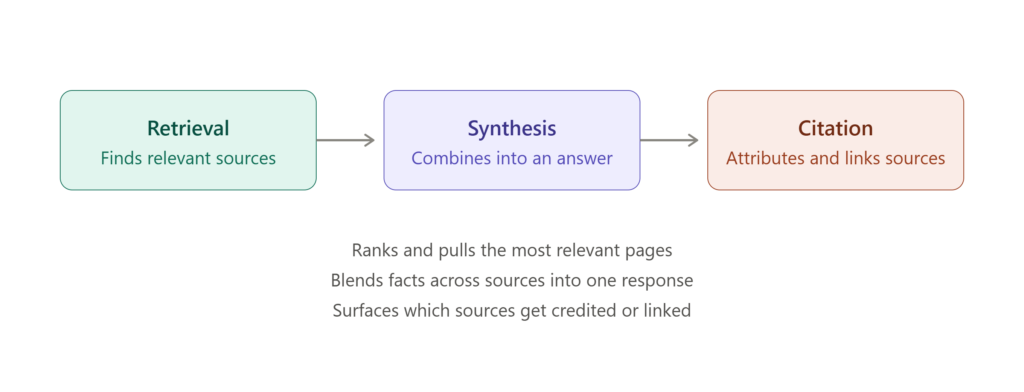
Understanding the mechanics helps you optimize with intention rather than guesswork. Generative engines generally work in three stages:
- Retrieval — the system pulls a set of candidate documents relevant to the user’s query, similar to how a search engine indexes and retrieves pages.
- Synthesis — it compresses and combines information from multiple sources into a coherent answer, rather than just linking to one page.
- Citation/attribution — where the underlying platform supports it, the system attributes specific claims to specific sources.
To succeed at all three stages, your content needs to be:
- Easy to retrieve — technically crawlable, fast, and clearly structured (the SEO fundamentals still apply here).
- Easy to extract — organized into clean sections with clear headings, so a system parsing your page can isolate the specific fact or answer it needs without wading through unrelated text.
- Evidence-rich and specific — vague, generic statements get compressed away during synthesis; specific numbers, named methods, and concrete claims are more likely to survive into the final answer.
- Consistent across the web — if your business’s name, services, and key facts are described consistently across your site, directories, and other authoritative mentions, AI systems have more confidence citing you accurately.
The GEO Implementation Checklist
Use this as a working checklist against your own site, page by page.
Content structure
- Every page has one clear H1 and a logical H2/H3 hierarchy — never skipped or out of order
- Key sections open with a direct, quotable answer before the supporting explanation
- Long-form pages include a short summary near the top or end of major sections
- Lists, tables, and step-by-step instructions are used wherever the content is naturally sequential or comparative
Entity and authority signals
- Your business, services, and key facts are described the same way across your site, Google Business Profile, and major directories
- Pages name specific tools, standards, or methods rather than speaking in generalities
- Author or organizational expertise is visible (author bios, credentials, case studies, real client results)
- Claims are backed by data or named sources rather than unverified assertions
Technical foundation
- Pages load quickly and render cleanly on mobile
- Structured data (schema markup) is implemented on key page types
- Content is crawlable — no critical information locked behind JavaScript that isn’t rendered for crawlers
- URLs, titles, and headings are descriptive rather than generic
FAQ and question coverage
- Pages answer the actual questions people ask about the topic, in question-and-answer format
- FAQ content is marked up with FAQ schema where appropriate
Schema Markup That Matters Most for GEO
Structured data doesn’t guarantee an AI citation, but it removes ambiguity — and generative engines consistently favor unambiguous content. Prioritize these types:
- Organization schema — establishes who you are, clearly and machine-readably, across every page
- Article / BlogPosting schema — helps AI systems correctly attribute authorship and publish dates on your content
- FAQPage schema — directly maps to the question-answer format generative engines favor
- HowTo schema — valuable for any process-based content (“how to,” step-by-step guides)
- Service schema — clarifies exactly what you offer, which matters when AI systems are asked to recommend a provider
- BreadcrumbList schema — reinforces your site’s information architecture and topical relationships
You don’t need every schema type on every page. Start with Organization sitewide, then layer in Article/FAQPage/HowTo/Service schema based on what each page type actually is.
Common GEO Mistakes to Avoid
- Treating GEO as a keyword-stuffing exercise. Generative engines are synthesizing meaning, not counting keyword occurrences. Unnatural repetition doesn’t help and can hurt readability.
- Ignoring SEO fundamentals. GEO doesn’t work in a vacuum — if a page can’t be crawled or loads slowly, none of the content-structure work matters.
- Publishing thin, generic content. Vague statements get compressed away during AI synthesis. Specificity survives; fluff doesn’t.
- Inconsistent brand facts across the web. Conflicting information about your services, location, or offerings across different sites reduces an AI system’s confidence in citing you accurately.
- No measurement plan. Optimizing without tracking whether AI platforms are actually citing you means you’re flying blind.
How to Measure Whether GEO Is Working
GEO measurement is younger and messier than traditional SEO analytics, but there are practical signals worth tracking:
- Manual prompt testing — regularly ask ChatGPT, Gemini, Perplexity, and Google AI Overviews the questions your target customers would ask, and note whether/how your brand appears.
- Referral traffic from AI platforms — check your analytics for traffic sourced from chat.openai.com, perplexity.ai, gemini.google.com, and similar referrers; this segment is growing and worth isolating.
- Brand mention tracking — several emerging tools (and simple manual spot-checks) can track how often and how accurately your brand is described across AI answers.
- Search Console AI Overview data — where available, this shows impressions tied to AI Overview appearances, giving you a proxy for GEO visibility inside Google’s own generative results.
Treat this as a quarterly review process rather than a daily metric — AI answers change frequently as models update, so short-term fluctuations are normal.
GEO Case Example
A regional service business rebuilt its core “services” pages around the checklist above: each page opened with a direct one-sentence definition of the service, followed by a clearly structured breakdown of process, pricing factors, and FAQs, with Service and FAQPage schema added throughout. Over the following quarter, manual prompt testing showed the business appearing in AI-generated answers for several of its core service queries where it previously didn’t appear at all — alongside a modest but measurable uptick in referral traffic attributed to AI platforms. The lesson: the biggest gains often come from restructuring content you already have, not from producing more of it.
GEO Tools Worth Knowing
- Google Search Console — for AI Overview impression data where available
- Schema markup validators (e.g., Google’s Rich Results Test) — to confirm structured data is implemented correctly
- Manual AI prompt testing — still the most reliable way to check real-world citation behavior across platforms
- Emerging AI-visibility trackers — a growing category of tools built specifically to monitor brand mentions across generative engines
Conclusion
Generative Engine Optimization isn’t a separate discipline you bolt onto your marketing — it’s what SEO looks like now that AI systems are reading, synthesizing, and answering on your audience’s behalf. The businesses that win here aren’t the ones publishing the most content; they’re the ones structuring what they already have clearly enough for an AI system to trust and cite it.
Start with the checklist above: tighten your heading structure, lead with direct answers, add the schema types that matter most, and build a simple habit of testing your own brand’s visibility across AI platforms every few months.
Ready to make sure your business shows up when customers ask AI for recommendations? NexGN Solutions‘ AEO & GEO services can audit your current content and build a structured optimization plan tailored to your site. Book a free strategy call to get started.
Frequently Asked Questions
What is Generative Engine Optimization (GEO) in simple terms?
GEO is the practice of structuring your website content so AI tools like ChatGPT, Gemini, and Google AI Overviews can understand it and cite your business when answering related questions.
Is GEO the same as SEO?
No. SEO focuses on ranking your page in traditional search results; GEO focuses on getting your content cited or referenced inside an AI-generated answer. They share many underlying quality signals but target different outcomes.
Is GEO the same as AEO?
Not quite. AEO (Answer Engine Optimization) targets short, direct answers like featured snippets and voice search results. GEO targets comprehensive content that generative AI systems can summarize and cite. Many businesses need both.
Do I need to abandon my SEO strategy to focus on GEO?
No. GEO builds on SEO fundamentals — technical health, authority, and quality content still matter. Think of GEO as an additional layer, not a replacement.
How long does it take to see GEO results?
There’s no fixed timeline, since it depends on how AI models crawl and update their retrieval systems. Most businesses should treat it as a quarterly optimization cycle rather than expecting immediate change.
How do I know if AI platforms are citing my business?
Regularly test relevant questions directly in ChatGPT, Gemini, and Perplexity, and monitor referral traffic from AI platforms in your analytics alongside any AI Overview data available in Search Console.