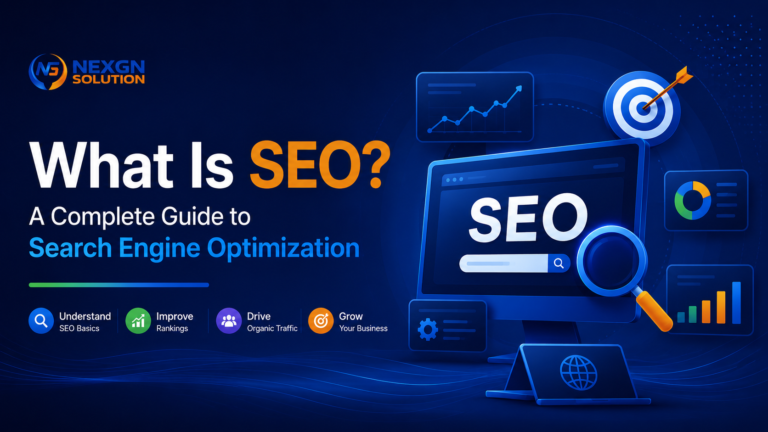
If you’ve ever wondered why some websites consistently appear at the top of Google search results, the answer often comes down to one thing: SEO.
Search engine optimization (SEO) is one of the most valuable skills a website owner can learn and an essential part of modern digital marketing. However, many people still view it as something mysterious, overly technical, or difficult to understand.
The truth is that SEO is much more approachable than it may seem.
This guide explains what SEO actually is, how search engines work, and how you can start using SEO as part of your digital marketing strategy to improve your website’s visibility and attract more organic traffic. Whether you’re a complete beginner, a small business owner, or someone trying to understand your digital marketing options, this guide will help you build a clear foundation in SEO.
What Is SEO?
SEO stands for search engine optimization. In simple terms, it’s the process of improving a website so that it appears higher in search results for relevant, unpaid searches on platforms like Google or Bing.
When someone searches for a product, service, or piece of information, search engines scan through billions of web pages to find the most relevant, trustworthy answers. SEO is how you help your website become one of those answers.
Unlike paid advertising, SEO doesn’t involve paying a search engine directly for placement. Instead, it focuses on earning visibility through relevance, quality, and trust. That’s why the traffic generated by SEO is often called organic traffic — it comes to you naturally, without a per-click cost.
A well-executed Search engine optimization strategy touches nearly every part of a website: the words on the page, the code behind the scenes, the speed at which pages load, and even the reputation your site has built across the web.
How Does SEO Work?
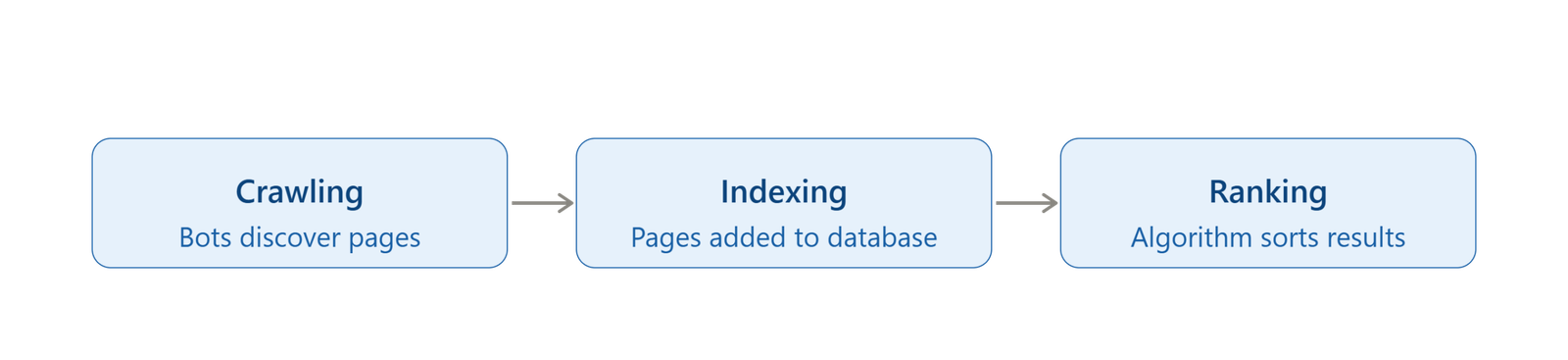
To understand SEO, it helps to understand how search engines actually operate. Google and other search engines rely on three core processes: crawling, indexing, and ranking.
Crawling is the discovery phase. Search engines send out automated programs, often called bots or spiders, that follow links from page to page across the internet. This is how they find new and updated content.
Indexing happens once a page has been crawled. The search engine analyses the page’s content and decides whether it’s eligible to be stored in its index — essentially a massive database of all the pages it considers useful enough to show in search results potentially.
Ranking is what happens when a user types in a search query. The search engine’s algorithm sorts through everything in its index and decides which pages best match that query, then displays them in order, from most to least relevant.
Search engines don’t reveal the exact formulas they use to rank pages, and those formulas change constantly. That’s why SEO is never a one-time task — it requires ongoing testing, monitoring, and adjustment as search engines refine how they evaluate content.
Why Is SEO Important?
SEO matters because search is often the starting point for how people discover businesses, products, and information online. If your website doesn’t show up when people search for what you offer, you’re relying entirely on other channels to reach them.
Here’s why SEO deserves a place in nearly every website’s marketing strategy:
- It drives consistent traffic. Once a page ranks well, it can continue attracting visitors for months or years without ongoing ad spend.
- It builds credibility. Many users trust organic results more than paid ads, associating high rankings with authority and relevance.
- It captures active demand. Unlike social media, where users stumble upon content, search users are actively looking for something — which often makes them more likely to convert.
- It supports long-term growth. SEO compounds over time. A well-optimized site tends to keep gaining visibility as it earns more trust signals and quality content.
- It improves the overall user experience. Many SEO best practices, like faster load times and clear navigation, also make a website better for visitors.
Without SEO, even a great website can remain invisible to the people who need it most.
The Main Types of SEO
Search engine optimization isn’t a single task; it’s a combination of different disciplines working together. Understanding each type helps you see where to focus your efforts.
dinfine in deatil builts point cover in heading
On-Page SEO
On-page SEO refers to all the elements and content you can optimize directly on your website’s pages. The goal is to help search engines understand your content while providing a better experience for visitors.
Unlike off-page SEO, which focuses on external factors such as backlinks and brand mentions, on-page SEO is completely within your control. Every page should be optimized around its topic, target audience, and search intent.
1. Keywords
Keywords are the words and phrases people type into search engines when looking for information, products, or services.
For example, someone searching for SEO services might use terms such as:
- SEO services
- SEO agency
- search engine optimization services
- SEO company near me
Effective keyword optimization involves understanding what your audience is searching for and naturally incorporating relevant terms into your content.
However, modern SEO is not about repeating a keyword as many times as possible. Search engines are increasingly better at understanding topics, context, synonyms, and user intent.
Best practices include:
- Choose a primary keyword that represents the main topic of the page.
- Use relevant secondary keywords naturally.
- Understand the search intent behind each keyword.
- Include related terms and concepts where they genuinely fit.
- Avoid keyword stuffing.
- Focus on creating content that fully answers the user’s question.
2. Title Tags
The title tag is the HTML title of a webpage. It often appears as the clickable blue headline in search engine results.
A well-optimized title tag helps both search engines and users understand what the page is about.
For example:
What Is SEO? A Complete Guide to Search Engine Optimization
A strong title tag should:
- Clearly describe the page’s main topic.
- Include the primary keyword naturally.
- Encourage users to click.
- Be unique for every important page.
- Accurately represent the content on the page.
Avoid creating titles that are misleading or overloaded with keywords. A title should be written for people first, while clearly communicating the page’s subject to search engines.
3. Meta Descriptions
A meta description is a short summary of a webpage that may appear below the title in search results.
Although meta descriptions are not generally considered a direct ranking factor, a well-written description can help improve the number of users who click on your result.
A good meta description should:
- Summarize the page accurately.
- Explain what the reader will learn or gain.
- Include the primary keyword naturally when relevant.
- Create a clear reason to click.
- Match the actual content on the page.
For example:
Learn what SEO is, how search engine optimization works, and how on-page, technical, and off-page SEO can improve your website’s organic visibility.
Search engines may sometimes display a different snippet from the page if they believe another section better matches the user’s search query.
4. Headings: H1, H2, and H3
Headings organize your content into a logical structure. They make long articles easier to read and help search engines understand the relationship between different sections.
A typical structure looks like this:
H1: What Is SEO? A Complete Guide
H2: What Is On-Page SEO?
H3: Keyword Optimization
H3: Title Tags
H2: What Is Technical SEO?
The H1 should normally represent the main topic of the page. The H2 headings divide the article into major sections, while H3 headings organize supporting topics within those sections.
Good heading practices include:
- Use one clear H1 for the main page topic.
- Use H2 headings for major sections.
- Use H3 headings for supporting subtopics.
- Make headings descriptive and useful.
- Maintain a logical hierarchy.
- Do not use headings simply to insert keywords.
A well-structured heading system allows readers to scan an article quickly and jump directly to the information they need.
5. Content Quality
Content is one of the most important elements of on-page SEO.
High-quality content should provide a clear, accurate, and useful answer to the user’s search query. It should not simply be written to include keywords or reach a specific word count.
Good SEO content should:
- Match the user’s search intent.
- Provide accurate and useful information.
- Answer the main question clearly.
- Cover relevant subtopics.
- Be original and well-researched.
- Use clear and readable language.
- Provide practical examples where appropriate.
- Be regularly updated when information changes.
For example, an article targeting “what is SEO” should not only define SEO. It should also explain how search engines work, the different types of SEO, keyword research, technical optimization, and how SEO supports organic growth.
The goal is to create the most useful answer for the reader—not simply the longest article.
6. URL Structure
A URL is the web address of a page. A clean and descriptive URL helps users and search engines understand the page’s subject.
For example:
Poor URL:
example.com/page?id=12345
Better URL:
example.com/what-is-seo
A good URL should generally be:
- Short and descriptive.
- Easy to read.
- Relevant to the page topic.
- Written using words rather than unnecessary numbers or symbols.
- Consistent with the website’s structure.
Avoid adding unnecessary keywords or changing URLs frequently without a valid reason. If an existing URL must be changed, use the appropriate redirect to help preserve the relationship between the old and new page.
7. Internal Linking
Internal linking means linking from one page on your website to another page on the same website.
For example, an article about SEO may link to related pages about:
- Keyword research
- Technical SEO
- SEO services
- Content marketing
Internal links help users discover related information and help search engines understand the structure and relationship between pages on a website.
Effective internal linking practices include:
- Link to genuinely relevant pages.
- Use descriptive anchor text.
- Connect related content naturally.
- Link important pages from relevant high-authority pages.
- Create logical content clusters.
- Avoid adding excessive links that make the content difficult to read.
A strong internal linking structure can help distribute authority throughout a website and make important pages easier for both users and search engines to discover.
8. Image Optimization
Images can improve content by making information easier to understand and more engaging. However, unoptimized images can also slow down a website.
Image optimization involves both technical and accessibility improvements.
Important practices include:
- Use descriptive file names.
- Compress images to reduce file size.
- Choose an appropriate image format.
- Add descriptive alt text where appropriate.
- Use responsive images for different screen sizes.
- Avoid using unnecessarily large image files.
For example:
Poor file name:
IMG_12345.jpg
Better file name:
on-page-seo-optimization.jpg
Poor alt text:
image
Better alt text:
SEO specialist analyzing on-page website optimization
Alt text should accurately describe the image when the image provides meaningful information. It should not be used as a place to insert keywords unnaturally.
9. Search Intent
Although search intent is closely connected to keyword research, it is also a crucial part of on-page SEO.
A page should satisfy what the user actually wants when they search for a particular query.
For example:
- “What is SEO?” usually has informational intent.
- “Best SEO tools” may have commercial investigation intent.
- “Buy SEO software” has transactional intent.
If the content does not match the user’s intent, even excellent technical optimization may not produce strong results.
Before optimizing a page, ask:
What does the searcher actually want to find?
Then create and structure the page around that need.
10. Content Readability and User Experience
On-page SEO is not only about search engines. The page must also be easy and enjoyable for real people to use.
A readable page should:
- Use short paragraphs.
- Include descriptive headings.
- Avoid large walls of text.
- Use bullet points when appropriate.
- Explain complex concepts clearly.
- Use images or visual elements where helpful.
- Make important information easy to find.
A visitor who cannot easily understand or navigate your content may leave the page quickly. Therefore, clear writing and a good user experience are important parts of effective on-page optimization.
Off-Page SEO
Off-page SEO covers the actions taken outside your website that influence how it’s perceived. The most significant factor here is backlinks — links from other websites pointing to yours.
Search engines treat backlinks somewhat like votes of confidence. When reputable, relevant sites link to your content, it signals that your page is trustworthy and worth ranking.
Off-page SEO also includes:
- Link building — actively earning or acquiring backlinks
- Brand mentions — references to your business, even without a link
- Digital PR — earning coverage or citations from news sites and industry publications
- Overall website authority — a general measure of how trusted your domain is
Technical SEO
Technical SEO focuses on the behind-the-scenes elements that determine whether search engines can properly access, understand, and rank your website. While users may not always see these elements directly, they play an important role in how search engines discover and evaluate your pages.
Key areas include:
- Site speed — Faster-loading pages provide a better user experience and can support better search performance. For example, a page that loads in 2 seconds is generally more user-friendly than one that takes 10 seconds.
- Mobile-friendliness — Your website should work properly on smartphones and tablets as well as desktop computers. For example, text should be readable without zooming and buttons should be easy to tap on a phone.
- Crawlability — This ensures search engine crawlers can navigate your website and discover its pages. For example, clear internal links help crawlers move from your homepage to important service pages.
- Indexability — This determines whether search engines can add your pages to their index and potentially show them in search results. For example, an important page blocked from indexing may never appear in Google.
- XML sitemaps — An XML sitemap is a file that lists important pages on your website and helps search engines discover them more efficiently. For example, a sitemap can help Google find a newly published blog post.
- Robots.txt — This file provides instructions to search engine crawlers about which areas of a website they can or cannot access. For example, you may use it to prevent crawlers from accessing a private admin area.
- HTTPS — HTTPS encrypts the connection between a website and its visitors, helping protect data and creating a more secure browsing experience. For example, websites using HTTPS display a secure connection in the browser.
- Core Web Vitals — These are Google’s user-experience metrics that measure important aspects of page performance, including loading speed, interactivity, and visual stability. For example, a page that loads quickly and does not unexpectedly shift while a user is reading provides a better experience.
- Structured data — Structured data is code that helps search engines better understand the information on a webpage. For example, adding structured data to a recipe page can help search engines understand its ingredients, cooking time, and ratings.
Even the best content can underperform if technical issues are blocking search engines from properly crawling or indexing it.
Local SEO
Local SEO helps businesses appear in search results when people look for products or services in a specific geographic area. For example, someone might search for “coffee shop near me” or “plumber in Chicago.”
It is especially important for businesses that serve customers in a particular location, such as restaurants, clinics, service providers, stores, and local agencies.
Key components include:
- Google Business Profile:Your business listing that can appear in Google Search and Maps. For example, a restaurant’s profile may show its location, hours, phone number, photos, and customer reviews.
- Local citations — Online mentions of your business name, address, and phone number on directories and other websites. For example, a local business directory may list your company along with its contact information.
- Reviews — Customer feedback that helps build trust and can influence how people choose between local businesses. For example, a business with many positive reviews may attract more potential customers.
- NAP consistency — Keeping your Name, Address, and Phone number accurate and consistent across all online platforms. For example, your address should not appear differently on your website and business directories.
- Local keywords — Search terms that include a location or indicate local intent. For example, “SEO agency in New York” or “dentist near me.”
E-commerce SEO
E-commerce SEO applies core SEO principles specifically to online stores. This includes optimizing product pages and category pages with clear titles, descriptions, and relevant keywords.
It also involves using product schema markup so search engines can display extra details like pricing, availability, and reviews directly in search results. Technical optimization — such as fast load times and clean site architecture — is especially important for stores with large product catalogs.
How Search Engines Rank Websites
Search engines evaluate hundreds of signals when deciding how to rank a page, but most of them fall into a handful of major categories:
- Relevance — how well the content matches the search query
- Content quality — whether the page is genuinely helpful, accurate, and well-written
- Authority — how trusted the website and its content creators are, often reflected through backlinks and reputation
- User experience — page speed, mobile usability, and ease of navigation
- Technical performance — whether the site is crawlable, secure, and free of major errors
- Search intent match — whether the content format fits what the searcher actually wants
No single factor guarantees a top ranking. Search engines weigh these signals together, and the exact balance can shift depending on the type of search being performed.
What Are SEO Keywords?
Keywords are the words and phrases people type into search engines. They’re the foundation of SEO strategy because they reveal exactly what your audience is looking for.
Understanding search intent — the reason behind a search — is just as important as the keyword itself. Search intent generally falls into four categories:
- Informational — the user wants to learn something, like “what is SEO”
- Navigational — the user is trying to find a specific website or brand
- Commercial — the user is researching options before making a decision
- Transactional — the user is ready to take action, such as making a purchase
Matching your content to the correct intent is often more important than simply including the right keyword.
How to Do Keyword Research
Keyword research is the process of identifying the terms your audience actually searches for. A solid approach includes:
- Finding relevant topics related to your business or industry
- Understanding search intent behind each potential keyword
- Analyzing search volume and competition to gauge opportunity
- Identifying primary and secondary keywords to target on a page
- Finding long-tail keywords — longer, more specific phrases that are often easier to rank for
- Analyzing competitors to see what’s already working in your space
How to Create an SEO Strategy
A successful SEO strategy follows a structured, repeatable process:
- Website and SEO audit — assess your site’s current health and performance
- Keyword research — identify the terms worth targeting
- Competitor analysis — understand what’s already ranking and why
- Content planning — map out topics that align with keywords and intent
- On-page optimization — refine titles, headings, and content structure
- Technical SEO improvements — fix crawlability, speed, and indexing issues
- Link building and authority development — earn credible backlinks over time
- Performance tracking and continuous improvement — monitor results and adjust
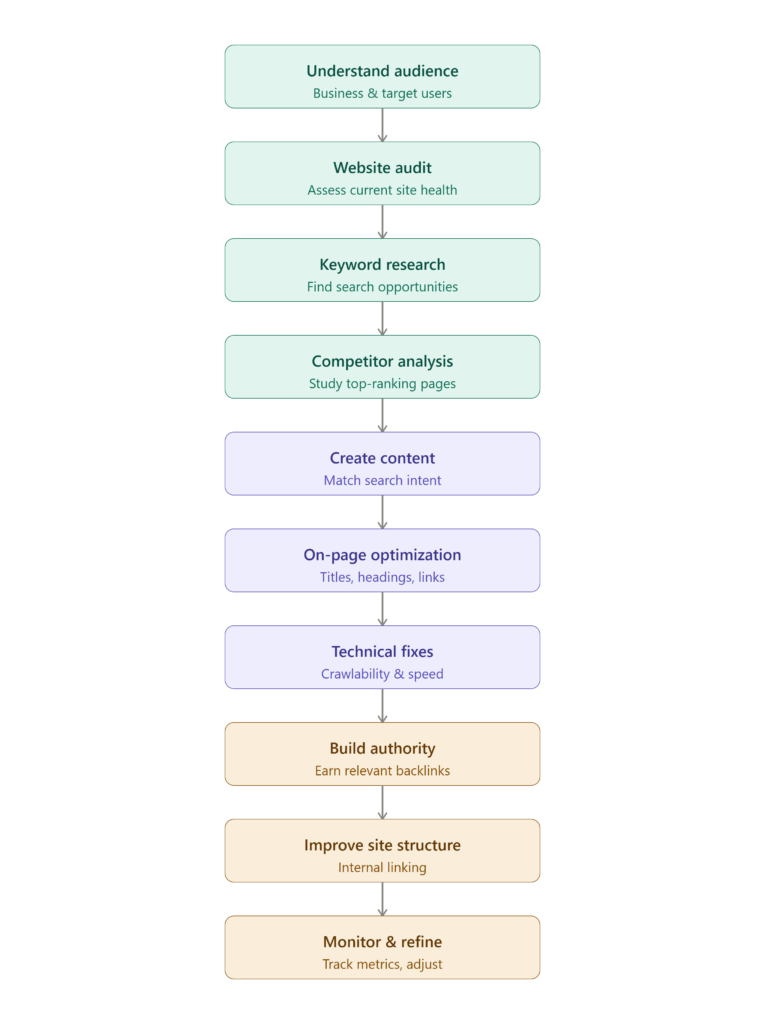
SEO isn’t a linear, one-time project. Each of these steps should be revisited regularly as your site grows and search engines evolve.
What Is SEO Content?
SEO content is content created with both the reader and search engines in mind — but the reader should always come first. Content that’s stuffed with keywords or written purely to satisfy an algorithm tends to perform poorly, because search engines are increasingly good at recognizing genuine quality.
Effective SEO content is:
- Original and accurate
- Focused on answering the searcher’s actual question
- Well-structured with clear headings
- Written in a natural, easy-to-read tone
Common SEO Mistakes to Avoid
Even experienced website owners fall into these traps:
- Keyword stuffing — overusing keywords in a way that feels unnatural
- Duplicate content — publishing the same or very similar content across multiple pages
- Buying low-quality backlinks — this can damage your site’s reputation and trigger penalties
- Ignoring technical SEO — great content can’t perform well on a broken or slow site
- Creating content without understanding search intent — even well-written content will underperform if it doesn’t match what searchers want
- Neglecting mobile optimization — most searches now happen on mobile devices
- Using misleading titles — this hurts trust and increases bounce rates
- Ignoring internal linking — missed opportunities to guide users and search engines through your site
- Focusing only on rankings instead of users — rankings should be a byproduct of serving users well, not the sole goal
How Long Does SEO Take to Work?
SEO is a long-term strategy, not an instant fix. Results depend on several factors, including your industry’s competitiveness, your website’s existing authority, the quality of your content, your technical health, and how consistently you execute your strategy.
Some websites start seeing modest improvements within a few weeks, while others — especially in competitive industries — may take several months to notice significant movement. Be cautious of anyone who promises guaranteed rankings or overnight results; legitimate SEO takes time and consistent effort.
How to Measure SEO Success
Tracking the right metrics helps you understand whether your SEO efforts are working. Important ones include:
- Organic traffic — visitors arriving through unpaid search results
- Keyword rankings — your position for target search terms
- Click-through rate (CTR) — the percentage of people who click your listing after seeing it
- Impressions — how often your page appears in search results
- Conversions — actions taken by visitors, such as purchases or form submissions
- Engagement — how users interact with your content once they arrive
- Backlinks — the number and quality of sites linking to you
- Domain or website authority — a general indicator of your site’s overall trust and strength
- Leads and revenue — the ultimate business impact of your SEO efforts
SEO Tools
A number of tools can help you research, execute, and monitor your SEO efforts:
- Google Search Console — a free tool that shows how your site performs in search, including clicks, impressions, and technical issues
- Google Analytics — tracks visitor behavior, traffic sources, and conversions
- Google Keyword Planner — useful for discovering keyword ideas and estimated search volume
- Semrush — an all-in-one platform for keyword research, site audits, and competitor analysis
- Ahrefs — widely used for backlink analysis, keyword research, and site auditing
- Screaming Frog — a crawler that helps identify technical SEO issues across a website
No single tool covers everything, so many SEO professionals use a combination depending on their specific needs.
SEO Best Practices for Beginners
If you’re just getting started, focus on these fundamentals first:
- Start with a technical audit to catch major crawlability or indexing issues
- Research keywords before writing content, not after
- Write for your audience first, and optimize naturally around that
- Keep titles and meta descriptions clear, relevant, and compelling
- Make sure your site loads quickly and works well on mobile
- Build internal links between related pages
- Earn backlinks through genuinely useful content rather than shortcuts
- Track your progress regularly instead of expecting instant results
Frequently Asked Questions
What is SEO in simple words?
SEO is the practice of improving a website so it ranks higher in unpaid search results, making it easier for people to find.
Why is SEO important for a website?
It helps websites attract consistent, cost-free traffic from people actively searching for related products, services, or information.
How does SEO work?
Search engines crawl the web to discover pages, index the ones they consider useful, and rank them based on relevance and quality when someone searches.
What are the main types of SEO?
The primary types are on-page SEO, off-page SEO, technical SEO, local SEO, and e-commerce SEO.
How long does SEO take to show results?
It varies widely, but many websites start seeing meaningful progress within a few months of consistent effort.